Teacher, coach, mentor. Taught K-12 and undergraduates. Founded and/or revived the debate clubs at two different schools. Designed and implemented curriculum for philosophy, literature, and history courses. Earned SEI Teacher Endorsement to make my teaching more welcoming for English learners. Love to invent fun extracurriculars and learning modules, such as “The History of Cycling” and “How To Make A Gingerbread House.” Presented widely on topics in phenomenology, aesthetics, and the philosophy of war.
Jump to:
K-12
With my younger students I try to inspire a sense of wonder at the world that will motivate them to explore ideas, develop their interests, and make them resilient in the face of setbacks in the long and winding road of learning.
At Meridian Academy (grades 6-12), a private day school in Boston, I taught Humanities (essentially, a blend of Literature and History) to a combined 6th and 7th grade classroom. The school uses an alternative curriculum model, freeing teachers to build their own curriculum with an emphasis on project-based learning. I served as faculty advisor to an advisee group. I designed “winter break” electives like “Building Gingerbread Houses.” And I revived the debate program, offering a modified version of the nationally-recognized NSDA student curriculum.
Goofing around with the Meridian advisee group!
At Eaglebrook School (grades 6-9), a private junior boarding school in western Massachusetts, I taught History and sundry electives, coached three sports (cross-country running, basketball, baseball), and lived in the residential dorms as a dorm parent.
There were two separate history courses: “American Government” (8th grade), similar to your typical Civics course, and “Mythology” (9th grade), a grade-appropriate adaptation of the ancient literature and mythology courses I taught at DePaul University.
The electives included an SSAT prep class, “World Views” (a “horizon expander” for graduating 9th graders leaving the nest), and other short learning modules such as a short “History of Cycling” (here’s the intro of a 7-part module) a primer on how to write a research paper, and media literacy curriculum. I also revived the debate program.

A couple of slideshows from the electives:
Debate
My background in debate comes from years of volunteering as judge or moderator for regional undergraduate debate tournaments in the Chicago-area. I was a graduate student in philosophy at the time, and I was drawn to volunteering both for the service aspect and also out of a desire to engage with methods of critical reasoning, analysis, and argument from a debate perspective.
I adapted what I learned in Chicago for middle and highschoolers. I revived the debate programs at Meridian Academy and Eaglebrook School, adopting age-appropriate curriculum from the National Speech & Debate Association to create learning and growth opportunities for my students. I prioritized the development of my students as critical thinkers and public speakers over the competitive aspect of formal debate. And I used the debate model as a structured learning activity in almost all my classrooms.
Here are two linked samples of “learning worksheets” I made for students, which we used either as in-class activities or preparation for in-class activities. These worksheets introduce the concepts of declamation and storytelling.
University
I held the position of adjunct faculty in the philosophy, language, and humanities departments of Loyola University Chicago, DePaul University, Dominican University, and Triton College from AY 2014-19. I held the position of teaching assistant from AY 2010-2014 while pursuing doctoral studies in philosophy at Loyola University Chicago.

A typical teaching load in a given semester would include an introductory course like “Ethics,” a more specialized philosophy elective like “Philosophy and Film,” and a literature course like “Classical Mythology.”
My teaching philosophy incorporates the general principle: “Meet students where they’re at.” For students in higher and continuing education, this means recognizing the complexities of balancing their studies with adult life, and optimizing the material and delivery to help them meet their learning goals.
I emphasized accessibility, clear instruction, concise materials, and a variety of delivery methods: in-classroom, online, hybrid, synchronous or asynchronous.
Courses Taught
University and College (AY 2013-2019)
*note: LUC= Loyola University Chicago
“Philosophy and Persons” PHIL 130 at SCPS LUC* (Chicago, IL: Summer 2018)
“Ethics” PHIL 181 at SCPS LUC (Chicago, IL: Spring, 2018)
“The Philosophical Vision” PHIL 190 at SCPS LUC (Chicago, IL: Spring, 2018)
“Ethics” PHIL 181 at SCPS LUC (Chicago, IL: Fall, 2017)
“The Philosophical Vision” PHIL 190 at SCPS LUC (Chicago, IL: Fall, 2017)
“Classical Mythology” MOL 210 at DePaul University (Chicago, IL: Fall, 2017)
“Philosophy and Film” PHIL 190 at Dominican University (River Forest, IL: Fall, 2017)
“Intro. to Philosophy” PHIL 160 at Dominican University (River Forest, IL: Spring, 2017)
“Ethics” PHIL 181 at SCPS LUC (Chicago, IL: Fall, 2016)
“Heroes and Epics” MOL 211 at DePaul University (Chicago, IL: Fall, 2016)
“Environmental Ethics” PHIL 231 at Dominican University (River Forest, IL: Fall, 2016)
“Philosophy and Film” PHIL 190 at Dominican University (River Forest, IL: Fall, 2016)
“Philosophy and Persons” PHIL 130 at LUC (Chicago, IL: Spring 2016)
“Heroes and Epics” MOL 211 at DePaul University (Chicago, IL: Winter, Spring, 2016)
“Classical Mythology” MOL 210 at DePaul University (Chicago, IL: Fall, 2015)
“Ethics” PHIL 181 at SCPS LUC (Chicago, IL: Fall 2015)
“Environmental Ethics” PHIL 287 at LUC (Chicago, IL: Fall, 2015)
“Intro. to Philosophy” PHL 101 at Triton College (River Grove, IL: Summer, 2015)
“Classical Mythology” MOL 210 at DePaul University (Chicago, IL: Winter, 2015)
“Classical Tragedy” MOL 212 at DePaul University (Chicago, IL: Fall, 2014)
“Philosophy and Persons” PHIL 130 at LUC (Chicago, IL: Fall, 2014)
Teaching Assistantships
PHIL 182 (Social & Political Philosophy, Spring 2014), Dr. Andrew Cutrofello (LUC)
PHIL 181 (Ethics, Fall 2013), Dr. Andrew Cutrofello (LUC)
PHIL 181 (Ethics, Spring 2013) Dr. Hugh Miller (LUC)
PHIL 181 (Ethics, Fall 2012) Hugh Miller and Jason Rheins (LUC)
PHIL 181 (Ethics, Spring 2012) Dr. Hugh Miller (LUC)
PHIL 181 (Ethics, Fall 2011) Dr. Hugh Miller (LUC)
PHIL 436 (Levinas, Spring 2011) Dr. Adriaan Peperzak (LUC)
PHIL 181 (Experimental Ethics, Fall 2010) Dr. Mark Waymack & Dr. Thomas Wren (LUC)
Presentations
I have been fortunate to find the opportunity to present my philosophical research in a variety of formats, including lectures, conference presentations (refereed and invited), commentaries, and posters.
Lecture
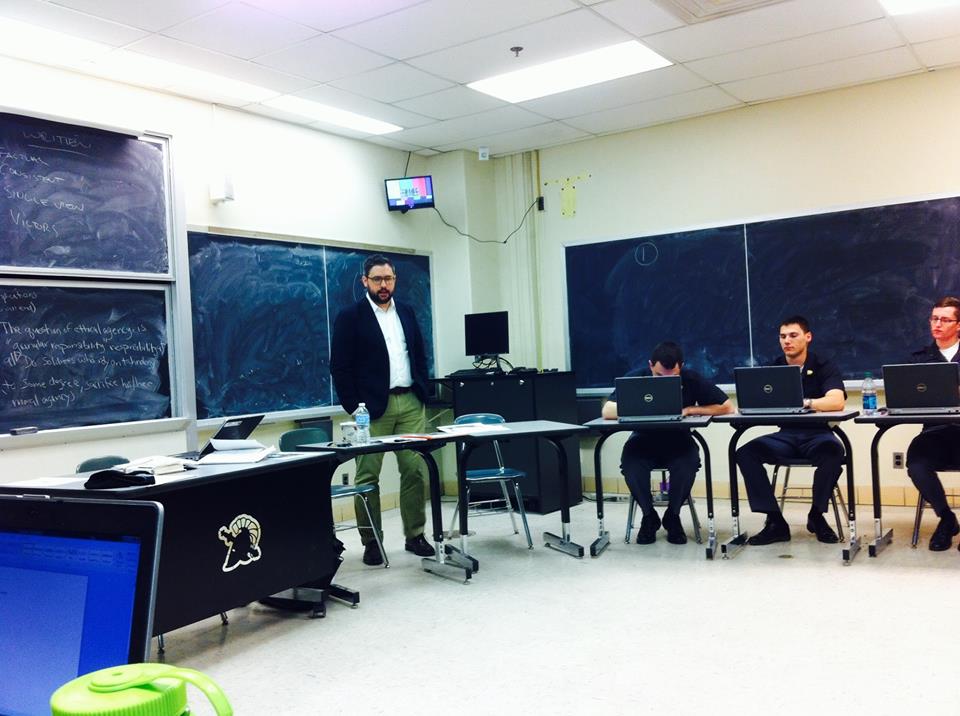
- “Ethics of Automated Warfare,” delivered at The United States Military Academy (West Point: March, 2014)
Presentations, Refereed
- “A Phenomenology of Motion and Rest in the Experience of the Art” at the Canadian Society for Aesthetics Annual Conference (Ryerson University, Toronto: May, 2017)
- “Husserl’s Regional Phenomenology of Nature and the Material A Priori,” presented at the Participants Conference of the Collegium Phaenomenologicum (Città di Castello, Italy: July, 2016)
- “Moral Responsiveness in Remote Warfare,” presented at the International Biennial Conference of the Inter-University Seminar on Armed Forces and Society (Chicago: October, 2015)
- “Intentionalism in the Work of Art and the Working of Art” presented at the Canadian Society for Aesthetics Annual Meeting (Brock University, Canada: May, 2014)
- “A Phenomenology of Weather Forecasting” presented at Back To The Things Themselves! Existential and Phenomenological Theory and Culture (Brock University, Canada: May, 2014)
- “The Priority of the Historical in Husserl’s Phenomenology,” presented at the Annual Meeting of the Nordic Society for Phenomenology (Helsinki, Finland: April, 2014)
- “Intentionalism, Allusion, and the Demands of Inter-Subjectivity,” presented at the American Society for Aesthetics Eastern Division Meeting (Philadelphia: March, 2014)
- “Personhood and the Region of Reversibility of Natural and Cultural Phenomena,” presented at Phenomenological Personhood, a meeting of the Phenomenology Research Group at the New School for Social Research (New York City: March, 2014)
- “Phenomenologies of Human and Robotic Military Comportment,” presented at the International Biennial Conference of the Inter-University Seminar on Armed Forces and Society (Chicago: October, 2013)
- “From Aristotle to Arendt: A Quick Philosophical Primer on the Basis of the Right to Protest,” presented at the People’s Summit (Chicago: 2012)
- “The Ethics of Algorithms: Empirical-Mathematical Cognitive Modeling in Target Assessment and the Phenomenological Response,” presented at The Ethics of Vicarious Warfare (Fort Leavenworth: 2012)
- “Two Poles of Authority in Two Platonic Dialogues,” presented at the meeting of the NAASN (Toronto: 2011)
- “Dots and Data: Seurat and Sartre,” presented at Locating Public(s) (UMASS/Amherst: 2009)
- “Of Dots, Data, and Magic: Seurat, Sartre, and Merleau-Ponty,” presented at Bodies in Motion (University of Rhode Island: 2009)
- “Theory and Practice in the Work of Art,” presented at the Hawaiian International Conference on Arts & Humanities (Hawaii: 2008)
Commentary
- Commentary on Akos Krassoy’s “Can Art Save Itself? Levinas in Dialogue with Sartre on the Freedom of the Aesthetic,” given at the American Society for Aesthetics Eastern Division Meeting (Philadelphia: 2015)
- Commentary on David Pena-Guzman’s “Synthesis Without Subjectivity,” given at the American Philosophical Association Eastern Meeting (Philadelphia: 2014)
- Commentary on Timothy Lord’s “The Weight of Wollheim on Collingwood’s Aesthetics,” given at the American Society for Aesthetics Annual Meeting (San Antonio: 2014)
Presentations, Invited
- “Internet, Ideology, and the Incipient Research Skills of Middle Schoolers” at the Junior Boarding School Association Conference (Eaglebrook School, Deerfield, MA: 2019)
- “The Medean Complex: the anxiety of disconnection in Husserl’s “world-annihilation” thought experiment” at the 11th Annual Graduate School Interdisciplinary Research Symposium (Loyola University, Chicago: April, 2018)
- “Causality and the Phenomenology of Substruction,” presented at the 14th Annual Phenomenology Roundtable (Canisius College, Buffalo: June, 2014)
- “Gelassenheit and Greasing the Wheel of Theoretical Advance in Husserl’s Philosophy of Science,” presented at Collegium Phaenomenologicum (Città di Castello, Italy: July 2013)
- “Whither the Science of the Life-World?,” presented at Who’s Afraid of Forms? (University of Calabria, Italy: July, 2013)
- “Epochal Thinking/Seeing,” presented at the 13th Annual Phenomenology Roundtable (LUC: May, 2013)
- “The Historicity of Causality Along Husserl’s Krisis Timeline,” presented at the 12th Annual Phenomenology Roundtable (Marquette University: May, 2012)
- “Dikē/Epokhē,” presented at the Phenomenology Research Group Workshop: Alterity and Meaning (LUC: 2012)
Posters
- “Phenomenology of Causality,” presented at the Loyola University Graduate School Research Conference as part of completing the Research Mentor Program award requirements (LUC: 2015)
 HOME
HOME 